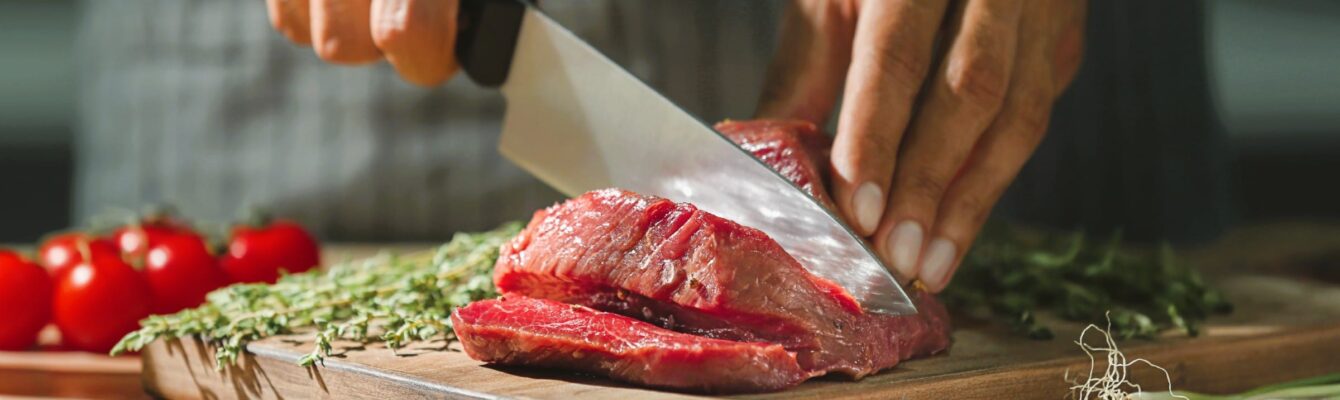





In the kitchen, the chef’s knife is much more than a simple utensil: it’s an extension of the hand, the indispensable tool for any successful preparation. Whether you’re a passionate amateur chef or a demanding professional, choosing the right chef’s knife is a crucial decision. It must be precise, balanced, durable, comfortable to handle and adapted to your cutting habits. But how do you find your way among the many brands, sizes, shapes and materials available? This article guides you step by step to understand the essential criteria and find the ideal chef’s knife, the one that will become your best everyday ally.
🔪What is a chef’s knife?
The chef’s knife, also known as the universal kitchen knife, is the most versatile instrument in the knife block. Its role is to make the majority of cuts: slice vegetables, slice meat, chop herbs, carve fish, even crush a clove of garlic or lift ingredients from the worktop to the saucepan.
His wide, slightly curved blade, typically measuring between 15 and 25 centimetres, allows a smooth rocking motion. This rounded profile facilitates back-and-forth cutting, ideal for onions, herbs or vegetables. The thick, rigid back of the blade lends strength, while the sharp point enables more precise gestures, such as cutting thin strips or incising skin.
Originally designed for professional chefs, the chef’s knife has become a staple tool in every kitchen. Versatile, it replaces several specialized knives on its own. Its balanced design between length, weight and ergonomics makes it a universal companion, capable of doing almost anything.
🍅Les usages du couteau de chef
One of this knife’s major assets lies in its exceptional versatility. It can be used for everyday preparations as well as more technical recipes.
For vegetables, it allows you to slice with regularity, finely slice or chop with speed. Thanks to its wide blade, it can also be used to crush certain foods, such as garlic, ginger or even seeds, before incorporating them into a preparation.
With meat and fish, the chef’s knife excels at detailing: it separates fillets, cuts pieces to the desired size and ensures clean cuts that respect the texture of the food. Unlike a boning knife, it is not designed to follow bones or joints, but ensures effortless, clean cuts on boneless pieces.
In pastry-making, it can also be useful for chopping chocolate, cutting dried fruit or dividing dough pieces. In short, it’s a central tool, often the first to grab when you start cooking.
Essential criteria for making the right choice
Choosing a chef’s knife is about more than aesthetics or brand: it’s about feeling, balance and durability. Several criteria come into play, and each must be evaluated according to your needs and your way of cooking.
The length of the blade
The standard size of a chef’s knife is between 20 and 21 cm, a versatile format suitable for most uses. A shorter blade, around 16 to 18 cm, will be better suited to smaller hands or kitchens with limited cutting space.
Inversely, a longer blade, 24 to 26 cm, offers a wide, fast gesture, appreciated by professionals handling large quantities of food. The important thing is to find a length proportionate to your hand and your work surface: a knife that’s too large can quickly become tiring to handle, while one that’s too small will lack power.
⚙️Le blade material
This is undoubtedly the most decisive criterion, as it influences cutting quality, durability and maintenance.
Stainless steel is the most common choice. It resists corrosion and is easy to clean. It’s a good compromise between sharpness and sturdiness, perfect for domestic use.
Carbon steel, which is harder, gives remarkably precise cutting and very fine sharpening. On the other hand, it oxidizes easily and requires regular maintenance to avoid rust.
Japanese steels (VG-10, AUS-10, etc.) or damascened blades combine several layers of metal to combine sharpness, elasticity and strength. They are prized for their beauty and efficiency, but are more expensive.
Finally, ceramic offers an extremely clean cut and won’t rust, but is brittle and difficult to resharpen. It’s not the best choice for a versatile chef’s knife, more for specific tasks.
Balance and weight
A good chef’s knife should feel like the natural extension of the hand. The balance between blade and handle is essential: if the blade is too heavy, the gesture becomes unstable; if the handle dominates, the cut loses precision.
Some prefer lightweight knives, often of Japanese inspiration, which allow fast, precise movements. Others prefer heavier, European-style knives, which facilitate clean cuts without forcing. It’s always best to take the knife in hand before purchase, to test the grip and the rocking motion.
The handle: comfort and material
The handle is often overlooked, but it plays a crucial role in comfort and safety. It must offer good ergonomics, a stable grip even when hands are wet, and not create pressure points after a few minutes of use.
Handles can be made of wood, plastic composite, micarta (fiber and resin), or stainless steel. Wood is pleasant to the touch, but requires a little maintenance; plastic and micarta are more hygienic and resist moisture. Steel, meanwhile, appeals for its minimalist aesthetic and durability, although it can be slipperier.
The important thing is that the shape of the handle fits your hand: some models are round, others oval or streamlined, according to Japanese or European tradition.
The type of sharpening
A well-chosen chef’s knife must be able to conserve its edge durably, but also be easy to maintain.
Japanese knives often feature a sharper sharpening angle (around 15°), offering an extremely fine cut. European models, on the other hand, have a slightly wider angle (20°), which is sturdier and more shock-tolerant.
A good compromise is to choose a steel of medium to high quality, which you can re-sharpen regularly with a stone or gun without difficulty. It’s better to have a knife that’s often maintained than one that’s supposedly “maintenance-free” but quickly dull.
💰The budget question
The price of a chef’s knife can vary from 30 to over 300 euros depending on brand, steel and finish. For a first purchase, there’s no need to aim for the most prestigious models: a mid-range knife, well-balanced and easy to maintain, will be more than sufficient.
Among the most recognized French brands of chef’s knives are Sabatier, Opinel, de Buyer, Goyon-Chazeau or 32 DUMAS, all stemming from the cutlery tradition of Thiers, France’s historic knife capital.
Internationally, major brands such as Wüsthof, Global, Kai, Sabatier, Victorinox or Zwilling offer reliable, recognized models. If you cook every day, a knife around 100 euros is often an excellent investment: it will last for years and offer incomparable cutting quality.
Chefs’ knife comparison
To help you find what you’re looking for, we’ve compiled a short comparison of the most popular references.
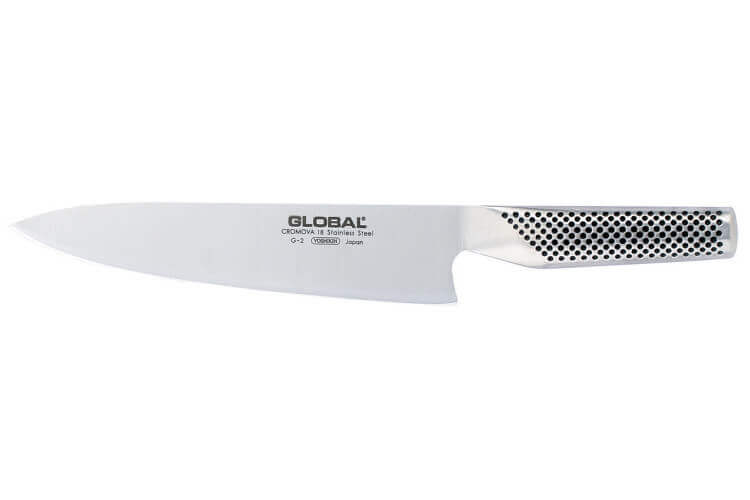 chez
chez Très beau couteau monobloc forgé à partir d'une seule pièce d'acier
Apprécié des cuisiniers professionnels
Fabriqué à Seki au Japon✅On aime
Lame 20cm en acier inoxydable trempé CROMOVA 18
Manche rond et creux pour une prise en main optimale chez
chez Couteau haut de gamme.
Pour un(e) passionné(e) ou semi-pro✅On aime
Superbe lame en acier damassé
Manche en Corian, matériau haut de gamme inspiré du marbre chezBon compromis pour usage quotidien solide
✅On aime
Beau manche bois
Fabrication « made in France », chezCouteau de qualité à prix maîtrisé
Acier forgé✅On aime
Marque Allemande réputée
Bonne qualité de fabrication
Plébiscité par les utilisateurs chezCouteau de qualité à prix maîtrisé
Acier forgé✅On aime
Marque Allemande réputée
Bonne qualité de fabrication
Plébiscité par les utilisateurs
❤️A chacun(e) son couteau !
Choosing your chef’s knife is a bit like choosing a musical instrument. It’s not just a question of technical performance, but also feel, balance and pleasure of use. A good knife should make you want to cook, inspire precision and confidence.
Take the time to hold it, test its weight, observe the quality of its blade. Between a Japanese model with a surgical edge and a solid, reassuring European knife, there is no universal “best” choice, only the one that suits you.
A well-chosen and well-maintained knife quickly becomes the most important utensil in our kitchen – the one we grab without a second thought, the faithful companion of all culinary creations, from simple evening dishes to the most ambitious recipes.








Leave a Reply