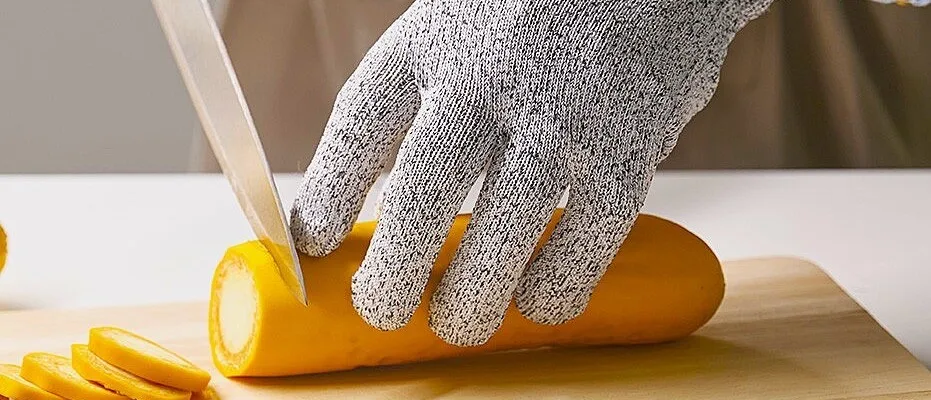





Here we present an indispensable kitchen tool to ensure the safety of chefs and budding cooks alike: the cut-resistant glove.
The kitchen is a place where accidents can happen quickly, and it’s vital to take all necessary measures to prevent injury. That’s where the cut-resistant glove comes in.
The characteristics of cut-resistant gloves
Cut-resistant gloves are designed to prevent accidents involving knives and other sharp tools used in the kitchen. They are generally made from tough materials such as kevlar, stainless steel or high-density polyethylene.
These materials offer optimum protection by reducing the risk of cuts caused by sharp blades. Cut-resistant gloves also often feature increased resistance to pressure levels to protect against possible punctures.
When should cut-resistant gloves be used?
Cut-resistant gloves are particularly indicated in the following situations.
🥕 When cutting with a knife
The cut-resistant glove proves invaluable when using a chef’s knife, paring knife or any knife with a thin blade. It allows you to work more serenely when slicing onions, chopping fresh herbs or trimming firm vegetables.
It also offers added safety when trimming meat, cutting poultry or lifting fillets – technical gestures where the hand often guides the blade.
🔪 With mandolin, rasps and microplanes
These tools are among the most accident-prone in the kitchen, as the fingers are very close to the blades. The use of an anti-cut glove is strongly recommended when grating parmesan, ginger, carrots or even when thinly slicing vegetables with a mandolin.
The glove acts as a protective barrier and prevents injury from rubbing too closely or slipping.
🧄For handling small or slippery foods
The risk of cuts increases when the food lacks stability: garlic cloves, shallots, juicy tomatoes, round cheeses, zucchini or thin carrots.
The anti-cut glove improves grip, secures cutting and helps hold produce without apprehension, even when wet.
🎃 When working with hard foods
The squash, potimarron and root vegetables often require more force and can cause the blade to deflect. On the other hand, their rounded shapes make them unstable and they can roll as you try to cut them.
Wearing a cut-resistant glove while cutting reduces risks, especially if you have to force or if the blade encounters tough areas.
🦪 With specific utensils
Beyond the obvious tools, the glove can be useful with more demanding accessories: hand chopper, serrated peeler, bread knife, oyster opener, or even charcuterie slicers.
Every time the non-dominant hand is exposed to a blade, the glove can prevent serious injury.
Criteria for choosing an anti-cut glove
🔪 Level of protection: the essential criterion
The first element to consider when choosing a cut-resistant glove is its level of resistance. In the kitchen, where gestures are rapid and blades sharp, a model offering sufficient protection is essential. Most gloves are graded according to the EN 388 standard, which assesses their resistance to abrasion, cutting, tearing and perforation.
For use with mandolin, Japanese knife or slicer, favor gloves with cut level 4 or 5, the highest for domestic use. This guarantees reliable protection during repeated cutting or prolonged preparation sessions.
🧵 Matière & fabrication : choisir un textile performant
Cut-resistant gloves are made from technical fibers designed to resist blades. Among the most effective materials are:
- HPPE (high-density polyethylene): lightweight, flexible and highly resistant
- Kevlar: appreciated for its robustness and durability
- Stainless steel or fiberglass mesh: ideal for intensive use
In practice, many models combine several fibers to maximize protection and comfort. For everyday cooking, a HPPE + fiberglass blend glove offers an excellent strength/softness ratio.
The steel-reinforced versions will be more suitable if you often handle very sharp knives or a ham slicer, for example.
✋ Comfort, softness and breathability
A very strong but rigid glove isn’t necessarily the best choice: if your movements are restricted, you’ll lose precision… and paradoxically, the risk of accidents increases. So make sure your glove is:
- soft, to feel the grip,
- breathable, to prevent sweating,
- assez fin, to preserve the feel of food.
The feel should remain natural: you should be able to grab a slippery vegetable, change the cut, adjust your mandoline… without being bothered.
📏 Size and fit: a detail that changes everything
An ill-fitting glove is a less secure glove. Too large, it will slip over your fingers and may get caught in the blade; too small, it will restrict your movements and become uncomfortable.
Most brands offer several sizes – sometimes even different ones for left and right hands. Take the time to consult the size guide: a precise fit improves both safety and efficiency in the kitchen.
🧽 Entretien & durabilité : un gant qui dure-plus-longtemps
Because a kitchen glove is often exposed to moisture, food scraps and oils, care is a key criterion. Choose a machine-washable model, which will facilitate daily hygiene.
Some gloves are also heat-resistant or dishwasher-safe, a plus if you cook a lot.
Our selection
Listed below are the cut-resistant glove references we’ve selected based on the above criteria.
 chez
chez
 chez
chez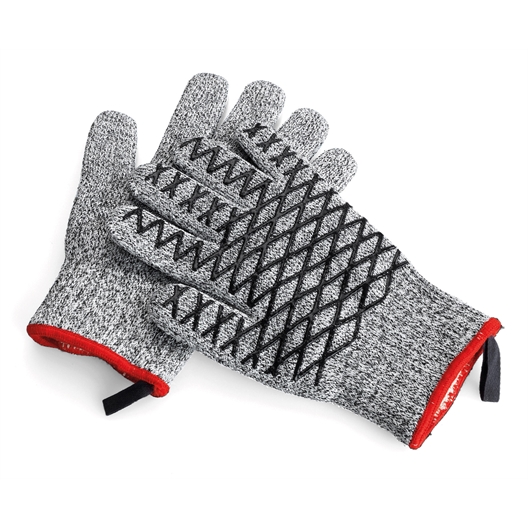 chez
chez
Protect yourself 🖐️
Cut-resistant gloves really are an essential accessory for any kitchen professional and even for passionate amateurs who frequently handle sharp utensils.
So get equipped and say goodbye to cuts in the kitchen!
Pour aller plus loin, venez découvrir toutes les recettes qui utilisent le gant anti-coupures.







Follow us on social media