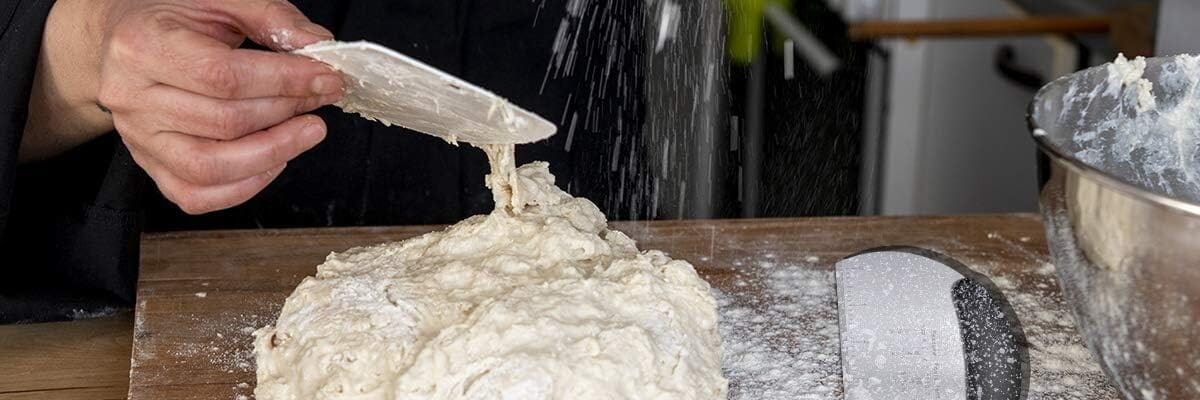





The pastry horn (also sometimes called raclette, coupe-pâtewhen it comes to the rigid model) is a seemingly simple, yet extremely versatile utensil.
Compact and sturdy, it facilitates dough handling, worktop cleaning and even block cutting of certain preparations – in short, a small tool that saves time and precision for anyone who cooks regularly.
Description
The horn usually takes the form of a rectangle with rounded corners. Its blade is short and wide (usually 8-12 cm wide and 6-10 cm high), and its back may be straight or slightly curved.
The cutting edge is not sharp like a knife: rather, it serves to separate, scrape, lift or distribute the dough. Depending on the model, it can be totally rigid (metal or hard plastic) or slightly flexible (silicone, soft plastic).
Origin of name
The word “horn” comes from the original shape of the tool. In the past, they were made from plates of horn or bone. The notion of “horn” can be found in other ancient utensils that use this material.
Today, the term has stuck around out of habit, even though the majority of modern horns are made of synthetic or metallic materials.
Materials: advantages and disadvantages
✔ Rigid plastic/polypropylene
- Advantages: lightweight, inexpensive, won’t scratch fragile surfaces, easy to handle.
- Disadvantages: less resistant to heat, can warp if subjected to too much pressure, possible wear over time.
✔ Silicone (or soft plastic)
- Advantages: flexible, perfect for scraping bowls and catching all the dough, resists heat well, often easy to clean.
- Disadvantages: less effective for cutting or portioning hard dough; if too soft, less precise for “loosening” dough stuck to the work surface.
✔ Acier inoxydable / métal (coupe pâte)
- Advantages: sturdy, ideal for cutting/dosing dough, scraping flour, transferring dough masses and cleaning work surfaces. Can also be used as a ruler for smoothing dough.
- Disadvantages: can scratch delicate surfaces (unvarnished wood), cooler to the touch, a little heavier.
Double use: spatula/dough-cutter
The horn combines two complementary functions:
✔ Spatula / squeegee
To scrape dough stuck to the bowl, recover the preparation, gather the dough finely, smooth the surface of a ganache or icing, or scrape residue off the work surface. Models in silicone or soft plastic excel in this role, as they conform to shapes.
✔ Cutting / portioning
For cutting and portioning bread dough, pastry, or shortcrust dough, for transferring dough pieces to a sheet, or for scraping off excess flour. The rigid or metallic models are more effective for cleanly separating dough pieces or sectioning sticky dough without damaging it.
🤲 How to use it – grip and useful gestures
Getting started
- Hold the horn with one hand, palm on the back of the utensil, thumb resting on the top edge to guide the pressure.
- The hand must remain supple: the horn is handled with short, controlled gestures.
basic-gestures
- Turning a bowl: tilt the horn slightly, slide it along the wall to loosen the dough and bring it together.
- Transferring a dough: slide the horn under the dough, making it “penetrate” under the edge, then gently lift to place it elsewhere.The Chef's TipFor very sticky doughs, pass the horn under a little flour to prevent it from sticking.
- Cutting / portioning: use the right edge of the horn to slice by pressing vertically and pulling slightly towards you
- Cleaning the work surface : you can gather the residues (flour, dough pieces) into a pile then scrape it directly into the garbage can or bowl.
- Smooth: the flat side can be used to smooth a ganache or slightly compress a spread paste.
💡Practical-tricks
- To prevent the dough from sticking to the horn: lightly moisten the edge or dust with a little flour.
- For very sticky doughs (brioche, greasy pie dough): prefer the metal horn to section, then the silicone horn to recover.
- When using the horn on unvarnished wood, protect the surface or prefer a plastic horn to avoid damaging it.
🍰In what preparations is the pastry horn useful?
Here are a few examples of preparations for which the pastry horn will come in very handy!
| Preparation types | Pastry horn uses |
| Buns & brioches | Portioning dough pieces, handling and folding dough, recovering leftovers |
| Sticky yeast doughs (brioche, fougasse) | Cutting, shaping and transfer to plate |
| Tart / shortbread dough | Gather dough, cut portions, smooth edges | Puff pastry & pâte sablée | Recover scraps, cut rectangles neatly, fold over dough |
| Fresh pasta / ravioli | Lift and transfer dough pieces, cut out elements | Biscuits & shortbread | Transfer cut shapes (ideally with a wide horn to avoid distortion) |
| Chocolate work / ganaches | Raculate walls, smooth, transfer | Cleaning & storage | Gather flour and residue for disposal or composting |
🛒Shopping tips
- For general pastry use: we recommend a horn made of soft silicone as well as one made of metal (or hard plastic) for cutting.
- If you work a lot with sticky dough: opt for a sturdy metal model + a silicone model for the bowl.
- Budget: horn is a small investment (< 10-15 € generally) but it simplifies work a lot and lasts a long time if you choose quality.
Our selection
Here you’ll find the references we’ve selected based on their origin and quality.
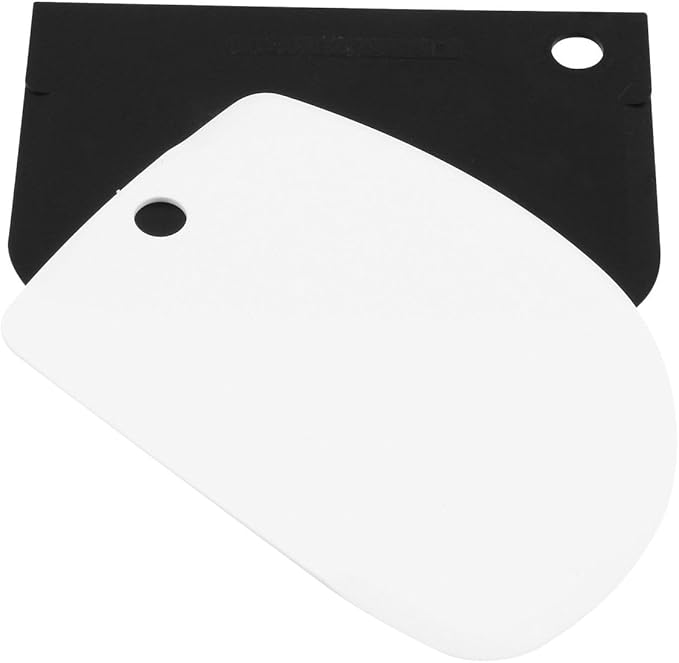 chez
chez Polyvalentes et durables
Forme ergonomique et flexible
Dimensions : 8 x 12 cm chezDimensions 15.2×10.9cm
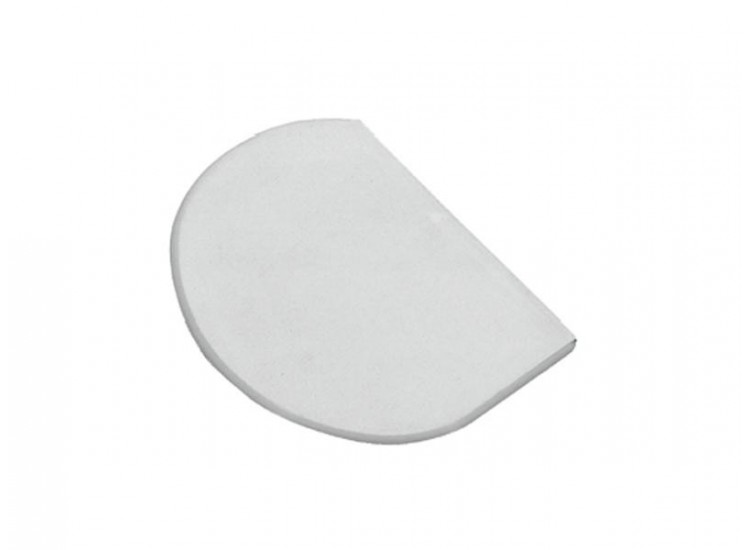 chez
chez Dimensions 11x15cm
Utilisable en racloir et coupe-pâte
Matière polyéthylène✅On aime
Marque française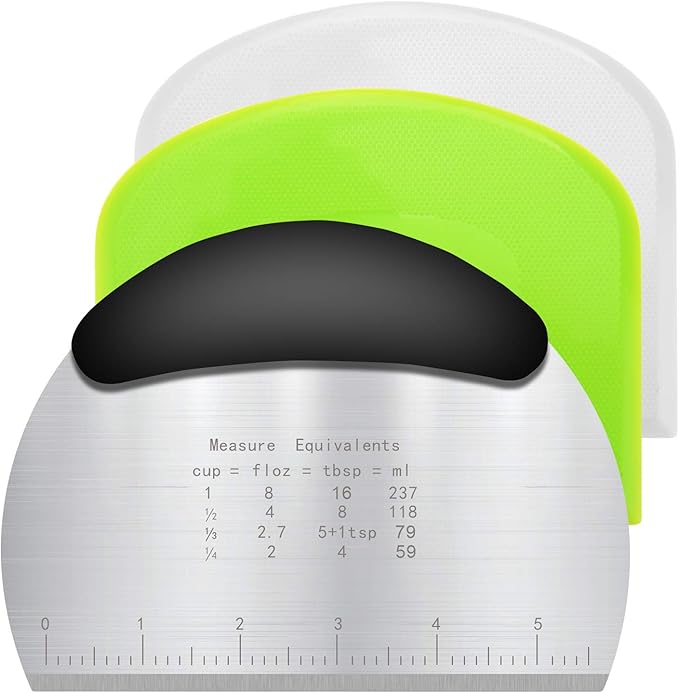 chezKit tout-en-un avec 3 cornes ayant chacune leur usage
Matériaux : plastique, inox✅On aime
Coupe-pâte gradué
In conclusion
The pastry horn is a simple tool, but oh so practical: it saves time, protects the work surface, makes handling sticky doughs easier, and makes storage and cleanup a breeze.
If you like to make homemade breads, thin pies or cookies, investing in a good horn (or even two: one soft, one stiff) is a good thing.
Pour aller plus loin, venez découvrir toutes les recettes qui utilisent la corne à pâtisserie !



Follow us on social media